Granny’s Ways Launch price ends Sunday ·  

The old household tricks · Written down at last

Four cheap things do the work of forty bottles.

You already know most of these tricks. What nobody ever wrote down for you is the part that got lost: how much to use, what to mix it with, what it will ruin, and when to leave it alone.

This is not a book pretending your grandmother had a microwave. Where a trick is genuinely old, I say when it was used. Where it is modern, I say so. And where something I grew up with turns out to be wrong, I say that too — there are a few, and they are the pages I would read first.

Get the Handbook — $50

Instant download · 60-day guarantee, keep the book · Read the math first

234 pages, 37 chapters 3 printable sheets included Prices checked August 2026
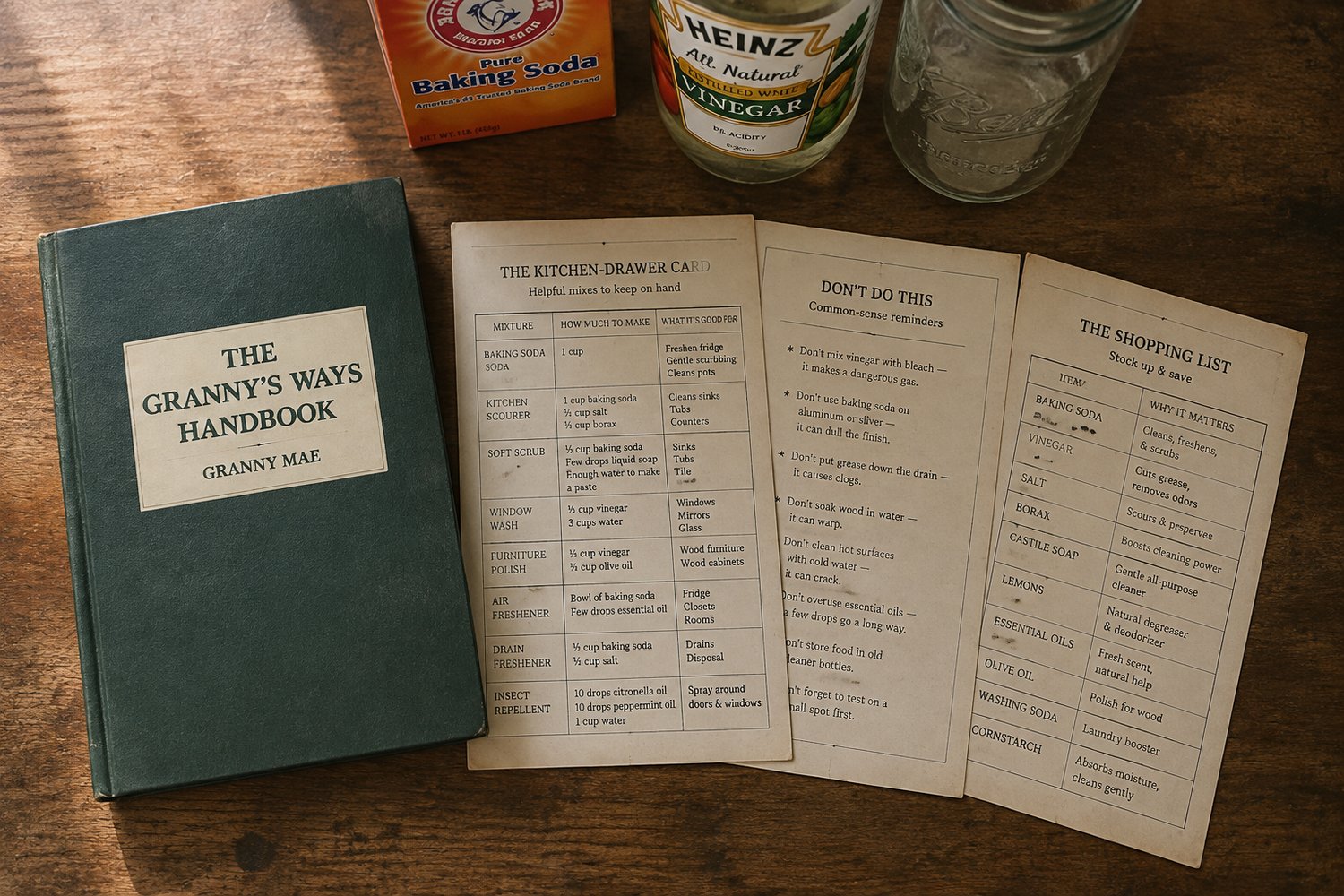
The Granny's Ways Handbook standing on a farmhouse kitchen table beside a box of baking soda and a bottle of white vinegar
The Granny’s Ways Handbook · Rosalind Gray

What you get

The book, and three sheets for the drawer.

  • The Granny’s Ways Handbook — 37 chapters, one jar at a time$50
  • The Kitchen-Drawer Card — the 12 mixes you’ll use most, with the amounts, on one page$27
  • Don’t Do This — 15 old tricks that can hurt you, and what to do instead$32
  • The Shopping List — what to buy, what it costs, what one jar stands in for$22
  • Altogether$131
$79 $50 once · not a subscription

Launch price until Sunday night. One call-out you don’t have to make is worth four of these.

Get the Handbook — $50

Downloads arrive by email straight away. Read it on the tablet, or print it.

The math

What the cupboard under your sink costs you every year.

Pull out everything under there and add up what you paid. Here is what an average household spends on the part these four things replace — laundry and cleaning products, paper goods, and the odds and ends.

Every yearThe bottlesThe cupboard four
Cleaning and laundry products, paper goods, odds and ends$617.30$34.51
Wearing out a fridge and a washer on schedule
One extra year each, from looking after them
$135.05$123.93
This book, paid once, in the first year only$0$50.00
First year$752.35$208.44

That is a difference of $543.91 in the first year, and about $593 every year after, once the book is paid for.

Now the honest part, because you would find it out anyway. That figure depends on how many of these you actually do. I have left out heating, home repairs and anything to do with haircuts, because I could not find a straight number that ties them to what is in this book, and I am not going to invent one to make the total look better.

Or look at it the other way.

Here is what one call you don’t have to make costs, at this year’s prices.

The call you didn’t makeWhat it costsTimes the book
Washing machine repair$2204.4×
A drain unblocked$2464.9×
Chimney swept$2545.1×
Refrigerator repair$2755.5×
A plumber$3406.8×
A new refrigerator$768.9915.4×

Even the smallest line there is more than four times the price of the book. That is the whole argument. It does not need dressing up.

Get the Handbook — $50

What’s inside

Thirty-seven chapters, one jar at a time.

Not room by room. Ingredient by ingredient, the way you actually reach for them — because once you know what a thing is, you stop needing a separate spray for every surface in the house. You do not have to do all of them.

Two chapters

Before you start

  • What’s actually in the cupboard, and what each thing is for
  • How I test a trick before I trust it
Five chapters

One box of baking soda

  • 12 things one box replaces
  • The burnt pot, rescued
  • Smells: the fridge, the bin, the shoes, the drain
  • Scrubbing without scratching — where soda is wrong
  • The laundry jobs soda does better than powder
Five chapters

One bottle of white vinegar

  • What 5 percent means, and when to water it down
  • Windows, kettles and shower heads
  • The stains it lifts and the three it sets
  • Vinegar in the wash
  • Never mix vinegar with these
Three chapters

A box of salt

  • Cast iron, and why soap was never the enemy
  • Spills, scorches and the red wine myth
  • Ice, drains and the jobs salt is genuinely best at
Four chapters

The jar of petroleum jelly

  • What it is, what it isn’t, and where I won’t put it
  • Hinges, zippers and drawers — and why the fridge seal wants wax, not jelly
  • Leather, patent shoes and handbags that crack
  • Heels, hands and lips — and what to use instead if you’d rather not
Three chapters

Old materials, modern substitutes

  • Newspaper is gone — what cleans glass now
  • Bar soap, candle stubs and a length of wool
  • The brands they trusted, and what’s left of them
Three chapters

The oils

  • Which oil for which job
  • Wood, furniture and the shine that lasts a week
  • Lashes, cuticles and skin — with the cautions
Four chapters

Making things last

  • Squeaks, sticks and things that won’t shut
  • Shoes, boots and the salt line
  • Pans, knives and the tools you’d otherwise replace
  • The ten-minute round that saves a repair bill
Two chapters

Warmth without the bill

  • Draughts, doors and the cost of a cold room
  • The house sweater, wool socks and warm feet
Four chapters

Skin, feet and hands at seventy

  • Cracked heels that come back every winter
  • Hands that wash twenty times a day
  • Itch, dryness and when it is not a home job
  • What the doctor actually said about it
Two chapters

Things I won’t tell you to do

  • Old tricks that were never safe
  • When to stop and call somebody

Why you can trust the rest of it

Four places this book argues against itself.

A book like this is easy to write badly. You list forty tricks, you promise they all work, and you never mention the ones that don’t. I would rather lose the argument on a page than have you find out at your own sink.

  • The scouring powder is cheaper than baking soda. Per scrub, it genuinely is. So the case against it in this book is bleach and scratching — not money.
  • The fridge seal does not want petroleum jelly. It is the tip I get asked about most. The rubber does not get on with it, and the people who make fridges say wax. Your instinct to look after the seal was right; the jar was wrong.
  • The open box in the fridge was an advertising idea from 1972. Not something your grandmother did. What actually works is the paste, on the thing itself.
  • Salt does not lift red wine. It has been tested properly, and salt is what the dye trade uses to drive colour into cotton.
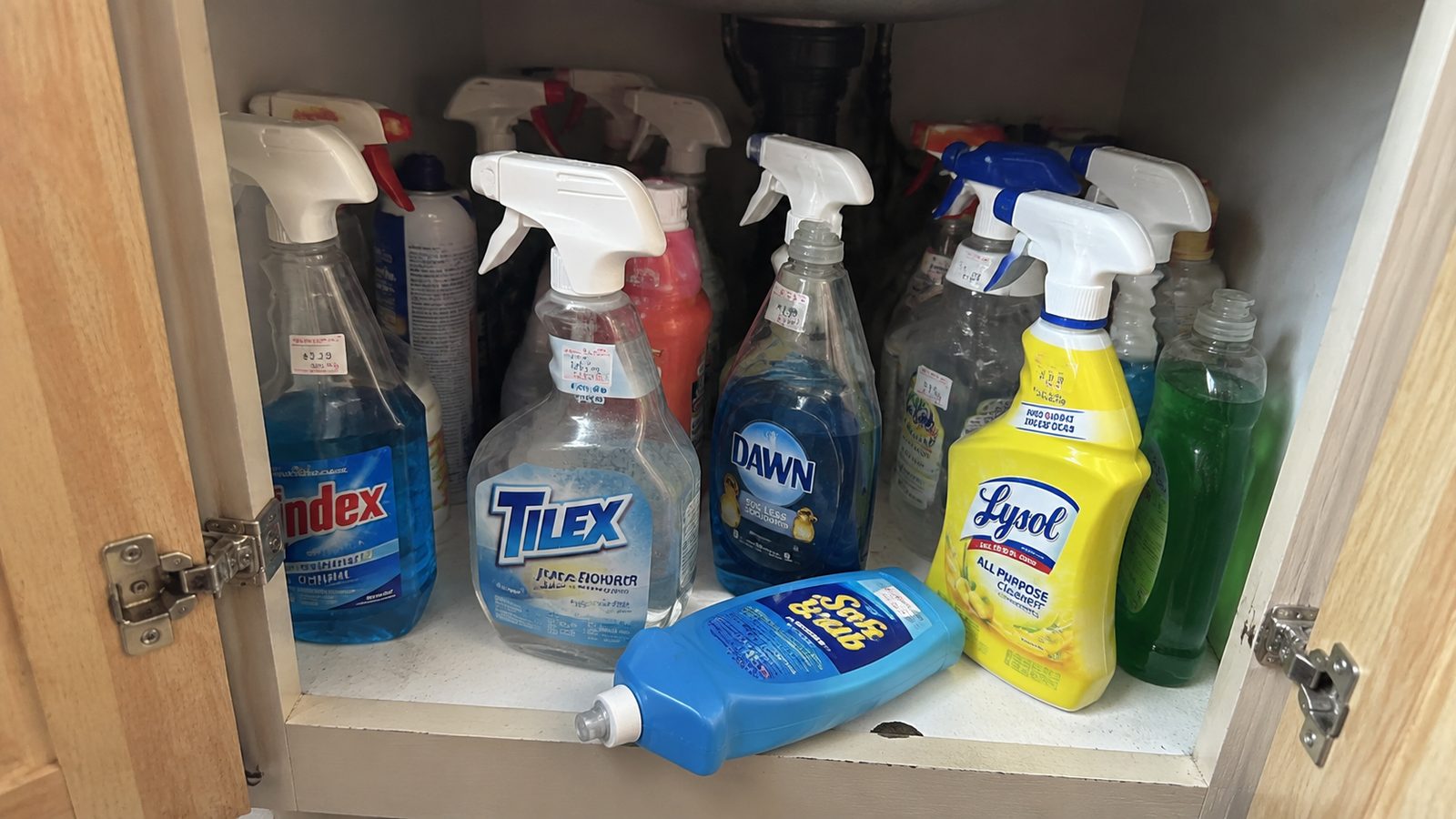
A cupboard under a kitchen sink crowded with a dozen half-used branded cleaning sprays
A dozen bottles, most half used, and four of them doing a job one box already did.

What people say about these tricks

You already know this works. That is rather the point.

These are comments left under videos about these old household tricks, word for word, with the number of people who agreed. They are not reviews of this book — the book is new. They are here because the loudest thing in every one of those comment sections is somebody adding the trick the video missed.

“Thanks. I remember these. But you forgot one that we always used. Put a little Vaseline on pattern leather shoes, and purses. It saved them from cracking.”

Marlene K. · Ohio ·

“Brought back many memories. The only remedy for drawers that wouldn’t slide easily we used and still use is a candle rubbed along the slide. I’m still smiling at 93.”

Vona T. · Kentucky ·

“My GMA always said ‘it takes grease to cut grease’ so she put a small dab of Vaseline on any grease spot rubbed it in real good and the grease spot came right out.”

Cheryl A. · Missouri ·

“Burnt pots and pans. I have learn use vinegar and baking soda instead all these cleaners you buy. Money is to hard to come by. Thank You.”

Blanca R. · Texas ·

“Good stuff, but it still is petroleum.”

Andrew M. · Oregon · — and he is half right. Chapter 16 gives him the whole answer, including the number most people leave out.

“Nope! newspaper for glass cleaning! coffee filters are WAY TOO EXPENSIVE!”

Judy P. · Maine · — so I priced all three. Store-brand filters come to about 22 cents for twelve windows.

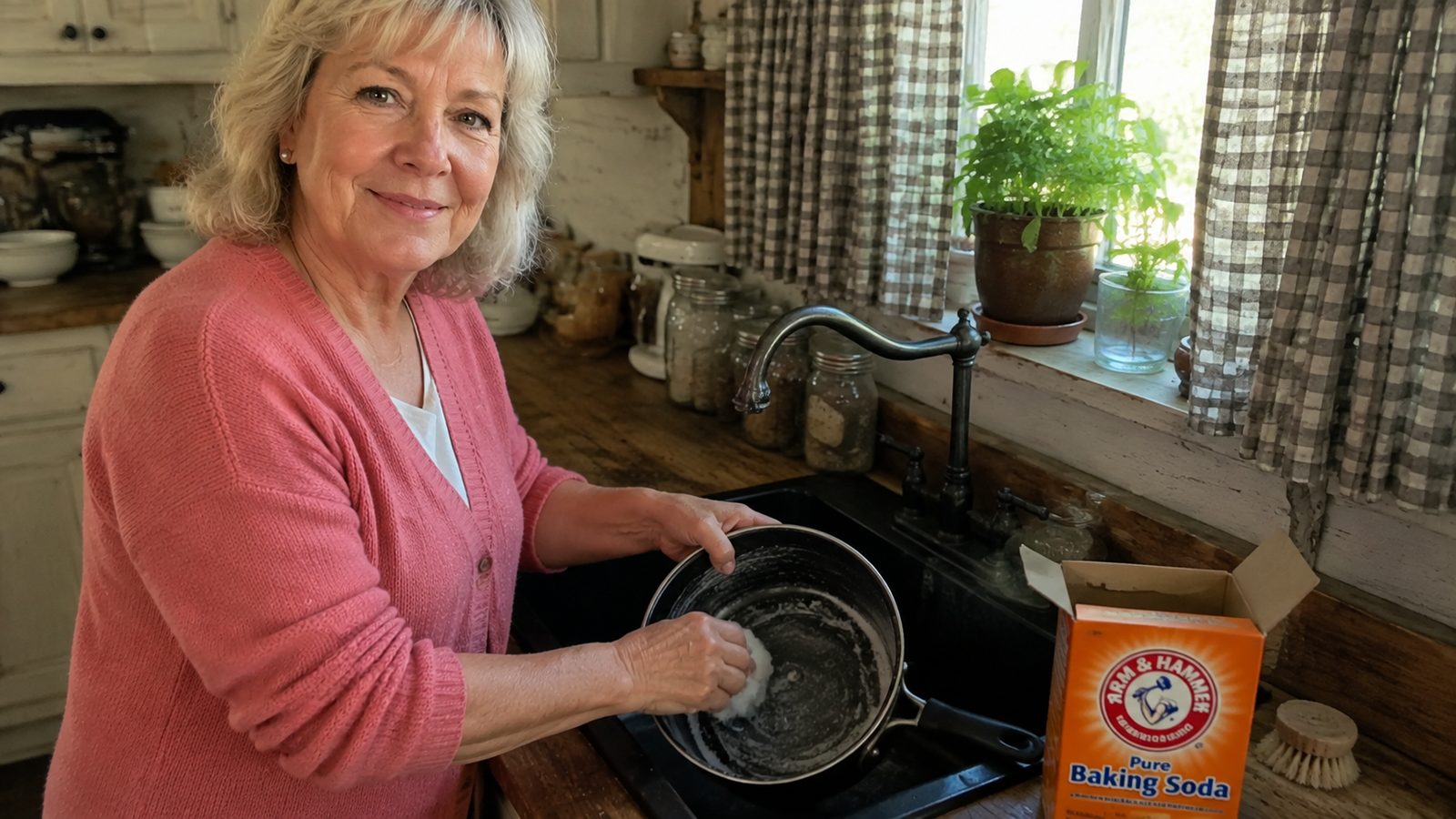
Rosalind Gray at her kitchen sink, scrubbing a burnt saucepan with baking soda

Who is telling you this

I’m Rosalind Gray.

I kept house for fifty years the old way — no gadgets, no expensive sprays, just the little tricks my own grandmother taught me. That is all my channel has ever been.

This book is that channel, put in order, with the part I can never fit into a video: the amounts. A video can tell you baking soda cleans a sink. It cannot easily stop and tell you it is two level tablespoons, that a one-pound box does about eight sinks, that it will not touch heavy baked-on grease, and that it is the wrong thing entirely for an aluminium pan.

Every price in it was checked this August. Every warning in it is there because somebody got hurt doing the thing without one.

The offer

$50 once. No subscription. Yours forever.

You have spent enough of your life paying monthly for things that used to be one-off. This is not one of those. You buy it, you download it, it is yours, and nobody bills you again.

$79$50once
  • The Handbook, 234 pages, 37 chaptersPDF
  • The Kitchen-Drawer Card1 page, print it
  • Don’t Do This1 page, print it
  • The Shopping List1 page, print it

Get the Handbook — $50

If it is not what you hoped for, email me inside 60 days and I send the $50 back the same day. Keep the book — I am not going to ask you to delete a file.

Questions people ask

Before you buy.

Isn’t all of this free on YouTube?
Most of the tricks, yes. The amounts, no. A list video tells you soda cleans a burnt pan; it does not tell you two to three inches of water and a quarter cup, simmer, switch off, and leave it. This is that channel with the measurements put back in, in order, in one place, with the warnings attached to the tricks that need them.
Is this a book, or something on a screen?
It is a PDF you download the moment you pay. Read it on a tablet or a computer, or print it — it is set 6 by 9 inches like a real book, and the three bonus sheets are made to be printed and kept in a drawer. There is no app and nothing to log into.
I’m not handy. Is it going to be over my head?
No. It is written the way I would say it across a kitchen table. Where a job genuinely needs a licensed person — gas, anything inside the electrical panel, a roof, old pipe lagging — the book says so plainly and tells you what the call costs, rather than talking you into something on a ladder.
I rent. Is it still worth it?
Most of it, yes. The cleaning, the laundry, the pans, the skin chapters and the draught-proofing all work in a rented place. The parts about appliances and gutters are for whoever owns the building.
I’m on a fixed income. Talk me out of it.
Fair. Do not buy it if you already own the four things and already know your amounts — you would be paying for tidiness. Do buy it if your cupboard is full of bottles you re-buy, or if you have ever thrown out a pan, a boot or an appliance that a ten-minute habit would have kept. If it does not earn the $50 back, ask for it back inside 60 days.
Is there more coming?
Yes — a laundry volume and a kitchen volume, and a printed edition that will lie flat on a counter. Buy this one and you get first word and a lower price on those. This book stays yours either way.

Stop re-buying forty bottles that four could do.

The tricks are going out of the world with the people who knew them. This is them written down, with the amounts, before that finishes happening.

Get the Handbook — $50

Launch price ends Sunday night · 60-day guarantee, keep the book

Before you go — the smallest number on the page.

One washing machine repair is $220. One drain unblocked is $246. The book is $50, once, and it is the only thing on that list you decide the price of in advance.

If it does not pay for itself, ask for the $50 back inside 60 days and keep the book anyway.

Get the Handbook — $50